How many English words do you know?
A free 48-question test that estimates your vocabulary size and the level it corresponds to.
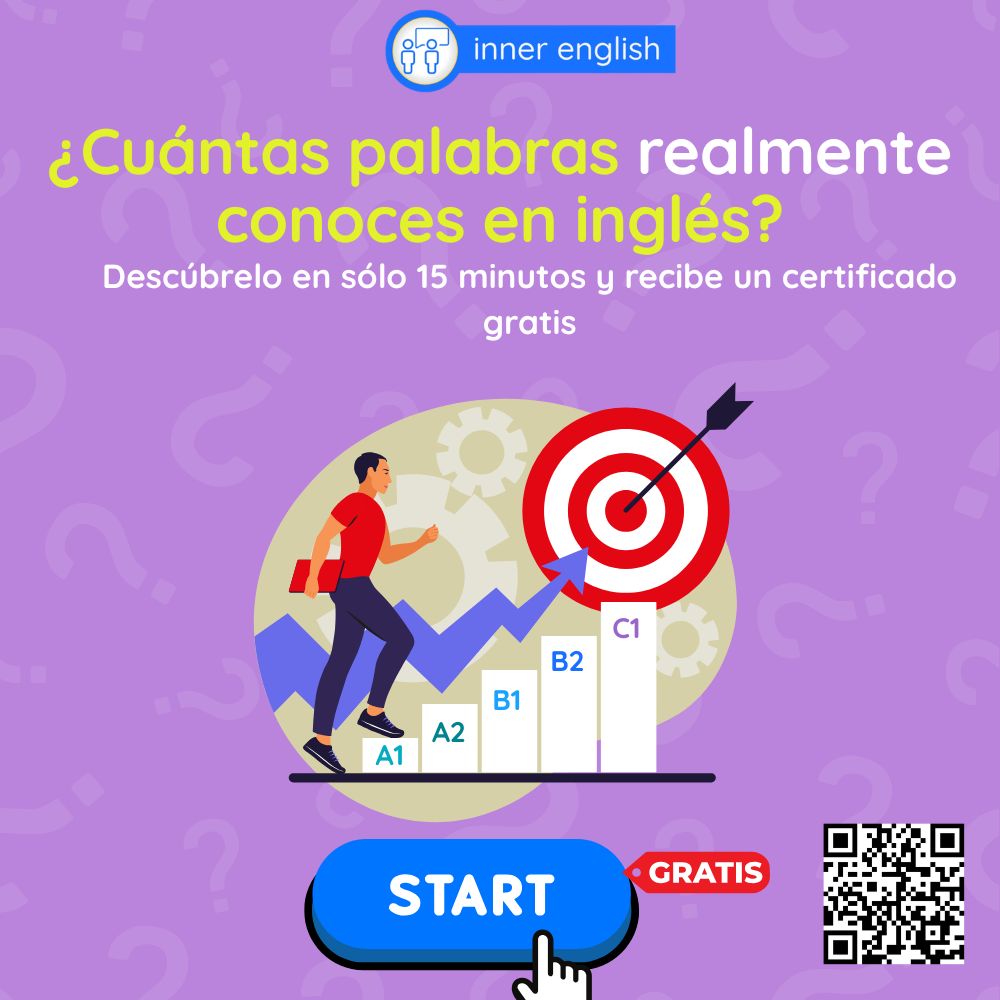
Vocabulary is one of the best indicators of your English: it determines how much you understand when reading, listening and talking. Our test is inspired by Paul Nation's Vocabulary Size Test, a method developed at Victoria University of Wellington and used worldwide.
Free · no card needed · instant result
How it works
| Step | What happens |
|---|---|
| 1. One word | You see an English word in a short sentence. |
| 2. Four options | You choose the closest meaning among four options. |
| 3. Honesty | If you don't know the word, you press "I don't know it". Random guessing distorts the result. |
| 4. Result | At the end you see roughly how many words you know and the level they correspond to. |
Words are chosen by frequency bands: from the most common to the least frequent. Your answers in each band make it possible to estimate how many words you know in total.
Free · no card needed · instant result
What does your result mean?
| Words | Vocabulary level |
|---|---|
| under 1,000 | Novice / Elementary |
| 1,000 – 3,000 | Beginner |
| 3,000 – 5,000 | Pre-intermediate |
| 5,000 – 8,000 | Intermediate |
| 8,000 – 12,000 | Upper-intermediate |
| 12,000 – 20,000 | Advanced / Proficient |
| over 20,000 | Expert / Near-native |
The test gives a useful estimate of your receptive vocabulary, not a lab measurement. The overall level is usually reliable; the exact number can vary by a few hundred words from day to day.
How many words do you really need?
Do you think you need to memorize thousands and thousands of words before you can speak? Linguist Paul Nation spent decades studying exactly this, and the answer is a relief:
| Words | What they let you do |
|---|---|
| 1,000 | Understand about 80% of everyday spoken English |
| 3,000 | Understand about 95% of most conversations |
| 8,000 – 9,000 | Read almost any text comfortably |
| 15,000 – 25,000+ | A native speaker |
With 3,000 words you understand 95% of a normal conversation. You don't need to be a walking dictionary: you need a solid base, and you build from there. A native speaker's extra words are hyper-specific and rarely appear in daily life.
Nation, I.S.P. (2006). How Large a Vocabulary Is Needed For Reading and Listening? Victoria University of Wellington / Canadian Modern Language Review.
I've taken several vocabulary tests and my results put me between
Your secret weapon: cognates
If you speak Spanish, you already know thousands of English words, and almost nobody takes advantage of it. Cognates are words that look alike and mean the same thing, because English and Spanish share roots from Latin and French. They aren't coincidences: they're family.
| English | Spanish | English | Spanish |
|---|---|---|---|
| hospital | hospital | important | importante |
| family | familia | possible | posible |
| music | música | university | universidad |
| communication | comunicación | responsible | responsable |
| culture | cultura | solution | solución |
| accident | accidente | perfect | perfecto |
English and Spanish are estimated to share
Careful: false cognates
Not everything that looks the same means the same. False friends look identical but mean something else, and they can lead to funny or embarrassing moments:
| English | Doesn't mean | Means |
|---|---|---|
| embarrassed | embarazada (pregnant) | ashamed |
| library | librería (bookstore) | a place to borrow books |
| actually | actualmente (currently) | in fact |
| carpet | carpeta (folder) | a rug |
| success | suceso (event) | achieving your goal |
| exit | éxito (success) | the way out |
False cognates are common traps, but they're quick to learn once you know they exist. And there are far more real cognates than false ones: less than 1% of shared academic vocabulary are false cognates.
Free · no card needed · instant result
Frequently asked questions
Is the vocabulary test free?
Yes, it is completely free.
How long does it take?
About 10 minutes to answer the 48 questions.
How many words do I need to speak English?
About 2,000 to 3,000 words let you understand most everyday conversations. For comfortable reading, 5,000 to 8,000 are recommended.
Can I retake it to measure my progress?
Yes. We recommend retaking it every few months to see your vocabulary grow.
Answer honestly: an "I don't know it" at the right time gives a more accurate result than a guess.
Conclusion
Knowing your vocabulary size lets you set concrete goals and measure your progress. Take the test today and retake it in a few months.
Free · no card needed · instant result