👋 Hey! Have you ever heard a native speaker say something like "break a leg" before a performance? They don't actually want anyone to break their leg! 😄 That's an idiom — a fun, fixed phrase with a special meaning. In this article, you will learn what idioms are, why they are super important, and 15 idioms that natives use all the time!
📚 What Is an Idiom?
An idiom is a group of words that has a meaning you cannot understand by reading each word alone. The meaning is different from the literal (real dictionary) meaning of the words.
💡
Simple definition
An idiom is a special phrase where the words together mean something completely different from their individual meanings. You need to learn them as a whole unit.
For example, if someone says "it's raining cats and dogs", animals are NOT falling from the sky! It just means it is raining very hard. 🌧️ The phrase is fixed — you cannot change the words. You need to learn the full expression as one unit.
📖
Key word: "literal"
When you speak literally, you use words with their exact dictionary meaning. When you use an idiom, the meaning is not literal — it is figurative (symbolic or imaginative).
25,000+
Idioms in English
4–6
Idioms per minute in conversation
15
Essential idioms in this lesson
🔥 Why Are Idioms So Important?
English is not just grammar and vocabulary lists. Real English — the English people use every day in conversations, TV shows, podcasts, and at work — is full of idioms. When you understand and use idioms correctly, you sound more natural, more fluent, and more connected to the language.
🎯
Think about it like this...
Knowing grammar rules is like knowing how to build a car engine. But idioms are the style, the personality, the paint color of the car. They make your English come alive!
Native speakers use idioms in every context — not just casual Friday-night conversations. You will hear them at the office, in formal meetings, in the news, in academic discussions, and even in business emails. Idioms are not "street talk." They are a normal, rich part of the English language.
⚠️ The Trap Most ESL Students Fall Into
Most English learners — even very good ones — make the same mistake: they learn grammar, they learn vocabulary, but they ignore idioms. Why? Because idioms are harder to learn from a textbook. They feel strange. They don't follow the rules. So students choose the safe, literal way to express things.
🚨
The result?
Your English sounds correct, but it sounds robotic. Natives immediately know you are reading from an "internal dictionary" instead of speaking naturally. You understand the language, but you don't sound like you live in it.
Look at this comparison. Both sentences are grammatically correct. But listen to how different they sound:
Situation
🗣️ Native with idiom
📖 ESL literal version
Before a performance
"Break a leg!"
"Good luck to you."
Explaining something quickly
"In a nutshell, we need more money."
"To summarize briefly and concisely, we need more money."
Something happened unexpectedly
"He called me out of the blue!"
"He called me without any previous warning."
Telling someone to wait
"Hold your horses! I'm not ready."
"Please wait. I am not ready yet."
Saying something is easy
"The exam was a piece of cake."
"The exam was very easy for me."
💛
You don't need to use idioms 100% of the time. But knowing them — and using 2 or 3 naturally in a conversation — makes a huge difference in how you sound!
🃏 Your 15 Essential Idioms
Here are the 15 idioms from your lessons. Click on each one to open the full explanation. For each idiom you will find: the definition, examples, and when to use it.
Opened0 / 15
1
Be a doll
▼
📖 Definition
To ask someone to be kind and helpful — to do a favor for you. It is a warm and friendly way to make a request.
💬 Examples
Native"Be a doll and grab me a coffee, will you?"
Native"She was a real doll — she helped me move all weekend."
ESL"Can you please do me a favor and get a coffee?"
📍
You use this when... you want to ask someone to do something kind or helpful for you. It adds warmth and friendliness to your request. Common between friends, family, and coworkers.
2
Break a leg
▼
📖 Definition
A way to wish someone good luck — especially before a performance, exam, or important event.
💬 Examples
Native"Your audition is today? Break a leg!"
Native"Big presentation tomorrow — break a leg, buddy!"
ESL"I hope you have good luck in your presentation."
📍
You use this when... someone is about to do something important — an exam, a job interview, a sports game, a performance, or any big moment. Do not say "good luck" in the theater world — "break a leg" is the tradition!
3
Cats and dogs
▼
📖 Definition
Used in the phrase "raining cats and dogs" — it means it is raining very heavily. No animals are involved! 😄
💬 Examples
Native"Don't forget your umbrella — it's raining cats and dogs out there!"
Native"The game was cancelled. It was raining cats and dogs."
ESL"It is raining a lot outside today."
📍
You use this when... it is raining very, very hard — a heavy storm. You always use it with the verb "raining": "It's raining cats and dogs."
4
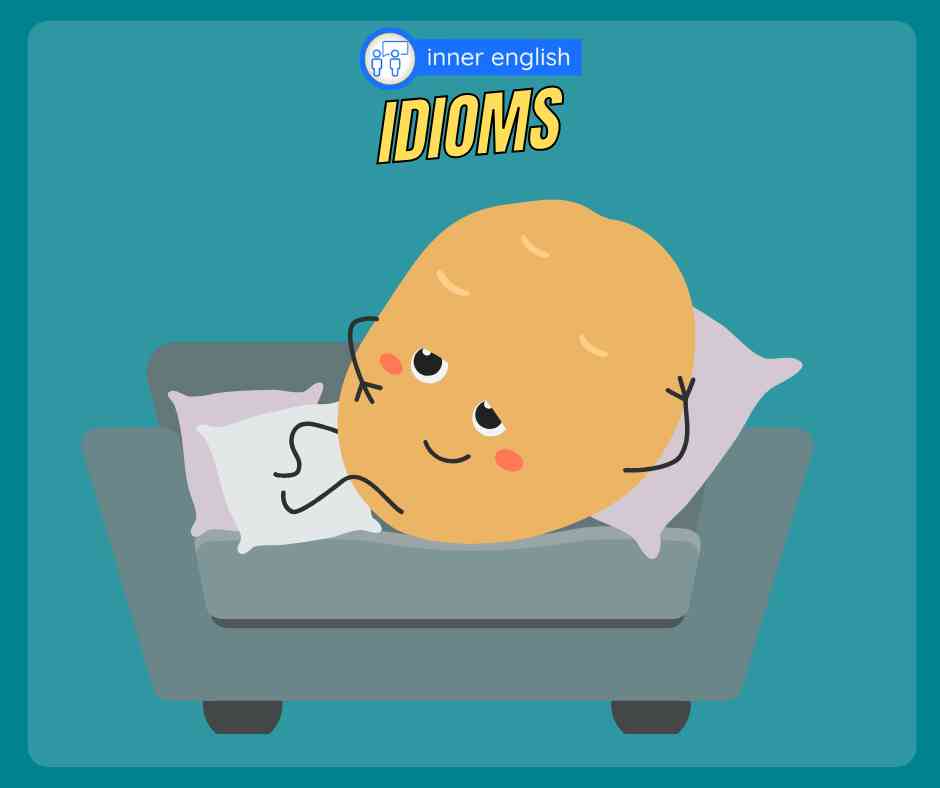
Couch potato
▼
📖 Definition
A person who spends a lot of time sitting on the sofa, watching TV, and doing very little physical activity. A lazy person.
💬 Examples
Native"Don't be such a couch potato — let's go for a walk!"
Native"My brother is a total couch potato on weekends."
ESL"My brother is a very lazy and inactive person on weekends."
📍
You use this when... you want to describe someone (or yourself!) who is being very lazy, sitting around, and not exercising. It is informal and often said in a joking or teasing way.
5
Time flies
▼
📖 Definition
Time passes very quickly — faster than you expected or noticed.
💬 Examples
Native"Wow, it's already December! Time flies when you're having fun."
Native"My daughter just turned 18 — time flies, I can't believe it."
ESL"The time passed very quickly. I did not notice how fast it went."
📍
You use this when... you notice that time has passed very quickly. The full saying is "time flies when you're having fun," but natives often just say "time flies!"
6
Hold your horses
▼
📖 Definition
Wait! Slow down! Don't go so fast or act too quickly.
💬 Examples
Native"Hold your horses! We need to check the plan before we move."
Native"Hold your horses — I haven't finished explaining yet!"
ESL"Please wait a moment. I have not finished explaining."
📍
You use this when... someone is moving too fast, making a decision too quickly, or interrupting you. It can sound playful or slightly impatient depending on the tone.
7
In a nutshell
▼
📖 Definition
To summarize something briefly — to explain the most important parts in a few words.
💬 Examples
Native"In a nutshell, the project failed because of poor communication."
Native"Can you explain the plan? — In a nutshell: we build, we test, we launch."
ESL"To summarize the main points briefly, the project failed due to communication."
📍
You use this when... you want to summarize a long explanation in a quick and simple way. Very common in business meetings, presentations, and everyday conversations. It sounds professional and smart!
8
Out of the blue
▼
📖 Definition
Something that happens suddenly and unexpectedly — with no warning at all.
💬 Examples
Native"Out of the blue, she quit her job and moved to Spain!"
Native"He texted me out of the blue after two years of silence."
ESL"Without any previous warning or notice, she quit her job."
📍
You use this when... something surprising happens with absolutely no warning — a phone call you didn't expect, a job offer, or a decision that seems to come from nowhere.
9
Piece of cake
▼
📖 Definition
Something that is very easy to do — no effort needed.
💬 Examples
Native"The driving test? Piece of cake. I passed on my first try."
Native"Don't worry about the installation — it's a piece of cake."
ESL"The exam was very easy. I did not have any difficulties."
📍
You use this when... a task turns out to be much easier than expected, or when you want to reassure someone that something will not be difficult.
10
Put a foot down
▼
📖 Definition
To be firm and refuse to accept something — to say "no" in a strong and final way. Also said as "put your foot down."
💬 Examples
Native"The kids wanted to stay up all night, but she put her foot down."
Native"The team kept changing the deadline. The manager put his foot down."
ESL"The manager firmly refused to allow any more deadline changes."
📍
You use this when... someone makes a clear and firm decision to stop a situation or behavior. Common in parenting, management, and relationships.
11
Ring a bell
▼
📖 Definition
To sound familiar — when something reminds you of something you have heard or seen before, but you are not 100% sure.
💬 Examples
Native"Does the name 'James Cooper' ring a bell?" — "Hmm, it does, actually."
Native"That song really rings a bell — what's it called?"
ESL"I think I have heard that name before, but I am not completely sure."
📍
You use this when... a name, place, song, or face seems familiar but you can't quite remember where you know it from. Also used as a question: "Does that ring a bell?"
12
Speak of the devil
▼
📖 Definition
Said when someone you were just talking about appears or contacts you at that exact moment.
💬 Examples
Native"We were just talking about Marco — speak of the devil, here he comes!"
Native"Did you hear from Sarah? — Speak of the devil, she just texted me!"
ESL"We were just talking about you and now you arrived at this moment."
📍
You use this when... the person you were just talking about suddenly appears — in person, by phone, or by message. It's always said with a smile and a bit of surprise. It's never negative!
13
On thin ice
▼
📖 Definition
To be in a risky or dangerous situation — where one wrong move could cause serious trouble.
💬 Examples
Native"He's on thin ice with his boss after missing two deadlines."
Native"Be careful what you say — you're already on thin ice with her."
ESL"He is in a very risky situation with his boss because of the missed deadlines."
📍
You use this when... someone is in a delicate situation where any small mistake could make things much worse. You can use it as a warning or to describe someone else's situation.
14
Under the weather
▼
📖 Definition
To feel sick or not feeling well — usually a mild illness like a cold or low energy.
💬 Examples
Native"I'm feeling a bit under the weather — I think I'm getting a cold."
Native"She won't be in today, she's been under the weather since Monday."
ESL"I am not feeling well today. I think I have a cold or something."
📍
You use this when... you feel sick but not seriously ill. Very polite and common in professional settings when calling in sick or explaining your absence. Works great in emails too!
15
Up and running
▼
📖 Definition
Working correctly and ready to use — especially after a problem, repair, or new setup.
💬 Examples
Native"The new system is finally up and running after last week's crash."
Native"We'll have the website up and running by Friday — don't worry."
ESL"The new system is now working correctly after the technical problems."
📍
You use this when... something (a system, machine, business, or website) is now working and fully operational — especially after a repair or initial setup. Very common in tech and business.
📖 Key Vocabulary from This Article
IdiomA phrase whose meaning is different from the individual words
LiteralUsing the exact dictionary meaning of each word
FigurativeUsing words in an imaginative or symbolic way
Native speakerA person who learned a language from birth
FluentSpeaking a language smoothly and naturally
ContextThe situation or setting where something is said
Ready to Sound More Native?
Keep practicing with Inner English! Every idiom you learn brings you one step closer to sounding natural and confident in English. 🚀